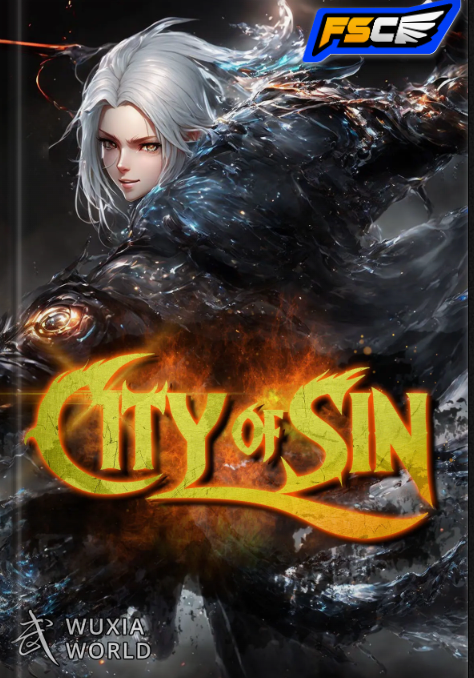
Every drop of this family bloodline is stained with sin. They are the embodiment of contradiction; calm yet maniacal, with great memories yet often forgetful. They pledge themselves to their dreams yet often compromise, are angels that are also devils… It’s why I hate them. And also love them. The only hope of his family, a youth with the blood of elves and demons walks on a battleground of annihilation and rebirth. He wills his way through boiling lava and icy depths, making a killing on this field of despair to strike down the lofty figure in his sight. One day he’ll grasp his blade tightly and survey his surroundings, only to find no more enemies to kill.
One-Sentence Positioning:
City of Sin is a grim, intellectually sharper-than-average Chinese fantasy epic about a gifted young man shaped by bloodline, politics, planar war, and moral compromise, less a clean power fantasy than a slow education in what greatness costs.
This Book Is For:
Readers who enjoy dark xuanhuan, academy-to-war progression, magic systems, bloodline inheritance, strategic battles, morally gray protagonists, clan politics, planar conquest, and stories where power is never separated from price.
This Book Is Not For:
Readers who want a simple good-versus-evil cultivation ride, constant wish fulfillment, lighthearted adventure, clean romance, or a protagonist whose choices always arrive wrapped in moral certainty.
3 Reasons to Recommend It:
1. It treats power like a system, not a decoration.
Many progression fantasies hand the protagonist strength and then ask the reader to applaud. City of Sin is more interesting because power here is tied to inheritance, education, military structure, social hierarchy, resources, and political violence. Richard’s growth does not feel like someone merely leveling up in isolation. It feels like a person being manufactured by a brutal world into someone capable of surviving it.
2. Richard is compelling because he is not comfortably heroic.
The novel’s central appeal is not that Richard is “nice.” It is that he is intelligent, damaged, observant, and increasingly willing to operate inside the ugly logic of his world. He is not written as a saint who accidentally becomes strong. He is closer to a blade being sharpened: useful, dangerous, and not always pleasant to look at too closely.
3. The scale keeps expanding without losing its sense of consequence.
City of Sin begins with personal origins and talent, then opens outward into noble houses, magic education, warfare, bloodline conflict, and planar struggle. That expansion is one of its biggest strengths. The story understands that epic fantasy becomes memorable not merely by making everything bigger, but by making each layer of scale change the protagonist’s responsibilities and compromises.
1 Deal-Breaker:
The novel’s darkness can feel genuinely heavy. Readers who dislike cruelty, sexual politics, morally uncomfortable relationships, or worlds where survival often matters more than kindness may find the book difficult rather than thrilling.
Editor’s Review:
City of Sin is one of those web novels that makes its title feel less like branding and more like a thesis. This is not a city of adventure, not a city of destiny, not a city of heroic arrival. It is a city, and eventually a world, built on appetite: for bloodline, status, territory, talent, bodies, loyalty, and power.
That is why the novel stands apart from more straightforward xuanhuan power fantasies. It certainly has the familiar pleasures of the genre: a gifted protagonist, elite training, dangerous enemies, escalating battlefields, rare abilities, and the constant promise that the world is larger and crueler than it first appears. But City of Sin is not content to let power remain clean. The book keeps asking what kind of person can rise in a world where family, empire, war, and desire are all transactional.
Richard begins as a character marked by origin and potential, but the novel is at its best when it refuses to make talent feel innocent. His abilities matter, but so do the institutions around him: noble houses, teachers, armies, contracts, bloodlines, and political expectations. That gives the story a harder edge. Richard does not simply “cultivate” upward; he is educated, used, tested, and gradually remade.
The result is a protagonist who can be fascinating without being easy to love. He is intelligent and capable, but not always comforting. He often feels less like a chosen hero than a product of pressure. That distinction matters. A chosen hero reassures the reader that power will eventually be used correctly. Richard does not offer that reassurance so neatly. His appeal lies in watching someone learn the grammar of domination and then become fluent in it.
This is also where the book will sharply divide readers. City of Sin has the kind of moral atmosphere that some readers find addictive and others find alienating. Its world can be harsh toward women, ruthless toward the weak, and emotionally cold in places where a more conventional fantasy would soften the blow. The novel’s defenders often praise its ambition, worldbuilding, and mature tone; its critics tend to point toward discomfort with its sexual politics, pacing, or the bleakness of its worldview. Both reactions make sense. This is not a book designed to be universally comfortable.
But discomfort is not automatically a flaw. In City of Sin, it is often part of the architecture. The world is ugly because the novel wants power to feel ugly. The danger is not only in monsters or enemy armies, but in the way institutions teach people to convert everything into advantage. That is what gives the story its bite. When Richard succeeds, the victory rarely feels pure. It feels earned, yes, but also stained.
The writing’s larger strength is its sense of scale. The novel does not remain trapped in one school, one clan, or one revenge plot. It keeps widening: from personal survival to elite education, from social conflict to military command, from local struggle to planar ambition. That movement gives City of Sin a grand, almost imperial rhythm. It is a story about becoming powerful enough to matter in a world that devours the powerless, and then discovering that mattering only places you in the path of larger hungers.
Final Verdict:
City of Sin is not the cleanest or softest entry point into Chinese fantasy, but it is a memorable one. It offers dark worldbuilding, strategic escalation, a morally complicated protagonist, and a fantasy world where ambition has teeth. For readers who want a polished, brutal, large-scale xuanhuan with political weight and psychological shadow, it is absolutely worth reading. For readers who need warmth, fairness, or easy moral comfort, this city may feel less like a destination and more like a warning.




 千斤顶
千斤顶









 English
 简体中文
简体中文 繁體中文
繁體中文 한국 사람
한국 사람 日本語
日本語 Deutsch
 русский
 بالعربية
 TÜRKÇE
 português
 คนไทย
คนไทย french