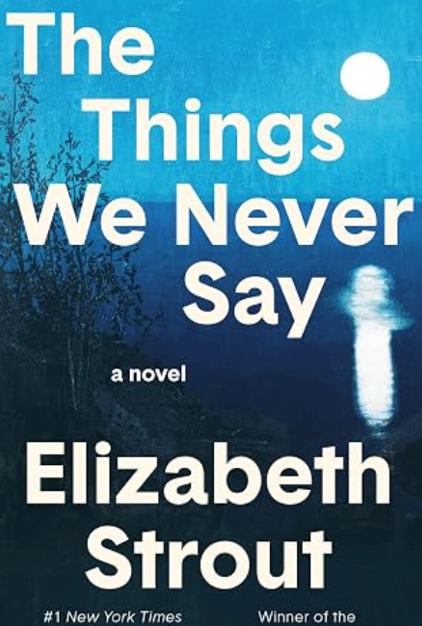
Artie Dam is living a double life. He spends his days teaching history to eleventh graders, expanding their young minds, correcting their casual cruelties, and lending a kind word to those who need it most. He goes to holiday parties with his wife of three decades, makes small talk with neighbors, and, on weekends, takes his sailboat out on the beautiful Massachusetts Bay. He is, by all appearances, present and alive. But inside, Artie is plagued by feelings of isolation. He looks out at a world gone mad—at himself and the people around him—and turns a question over and over in his mind: How is it that we know so little about one another, even those closest to us? And then, one day, Artie learns that life has been keeping a secret from him, one that threatens to upend his entire world. Once he learns it, he is forced to chart a new course, to reconsider the relationships he holds most dear—and to make peace with the mysteries at the heart of our existence. Elizabeth Strout, as we have come to expect, delivers a moving exploration of the human condition—one that brims with compassion for each and every one of her indelible characters. With exquisite prose and profound insight, The Things We Never Say takes one man’s fears and loneliness and makes them universal. And in the same breath, captures the abiding love that sustains and holds us all.
One-Sentence Positioning:
The Things We Never Say is a restrained but emotionally devastating literary novel about the loneliness people carry inside ordinary lives, and the painful truth that silence can be as destructive as any visible tragedy.
This Book Is For:
Readers who love literary fiction, emotionally precise family dramas, quiet character studies, New England settings, marital tension, father-son stories, psychological realism, and novels that find enormous meaning in small human gestures.
This Book Is Not For:
Readers who need fast pacing, dramatic plot twists, romantic escapism, clear villains, clean closure, or fiction that stays away from contemporary American politics and emotional despair.
3 Reasons to Recommend It:
1. Elizabeth Strout makes ordinary life feel morally enormous.
The novel follows Artie Dam, a 57-year-old high school history teacher in coastal Massachusetts, a man who appears decent, settled, and quietly respected. Yet beneath that surface is a life full of loneliness, marital distance, class discomfort, family trauma, and private dread. Strout’s gift is that she does not need melodrama to make this devastating. She can make a silence at dinner feel like a wound.
2. Artie is one of Strout’s most tenderly drawn male characters.
Artie is not a grand literary hero. He is awkward, kind, tired, frightened, and often painfully unable to say what he means. That is exactly why he works. He becomes a portrait of a certain kind of American man: emotionally intelligent enough to suffer deeply, but not fluent enough in intimacy to save himself easily. His relationship with his son Rob gives the novel some of its strongest emotional weight.
3. The novel turns private loneliness into a national mood.
The book is set against the anxious atmosphere of 2024 America, and critics have already read it as one of Strout’s most political works. But the politics are not just background noise. They seep into classrooms, marriages, friendships, and the nervous systems of ordinary people. Strout is not writing a campaign novel. She is writing about what happens when a country’s public fracture begins to deform private life.
1 Deal-Breaker:
This is a bleak, slow-burning book. Its emotional power comes from accumulation rather than plot velocity. If you dislike quiet novels about loneliness, depression, marital disappointment, family shame, and political unease, this may feel too heavy, too still, or too close to real life.
Editor’s Review:
The Things We Never Say is classic Elizabeth Strout, but it is not comfortable Elizabeth Strout. It has the plainspoken sentences, the New England air, the bruised marriages, the ordinary people carrying secret weather inside them. But this time the atmosphere feels colder, more politically charged, more existentially tired.
At the center is Artie Dam, a beloved history teacher whose life looks stable from the outside. He has a wife, a son, a home by the water, a profession that once gave him meaning. Yet Strout slowly reveals that Artie is not living so much as enduring. He is lonely in the specific way people become lonely when they are surrounded by others but cannot say the thing that would make them known.
That is the cruel intelligence of the title. The things we never say are not always dramatic confessions. Sometimes they are small, daily truths: I am scared. I am ashamed. I do not feel loved. I do not know how to reach you. I am still hurt by what happened years ago. I am not as fine as I look. Strout understands that silence is not empty. It gathers force. It becomes a second life inside the first one.
The novel’s family tragedy involving Artie’s son Rob gives the book its deepest ache. Strout is especially good at showing how a past event does not remain in the past. It rearranges a family. It changes the temperature of a marriage. It gives everyone a private room of guilt or grief, and then years pass, and people mistake endurance for healing. Artie, Evie, and Rob do not simply “move on.” They orbit the damage, each pretending the orbit is normal.
The political layer will be the most divisive part of the book. Some readers will admire the way Strout captures the dread of contemporary America without turning the novel into a lecture. Others may feel the political material presses too heavily on an already sorrowful story. Both readings are fair. The novel is at its strongest when national despair and personal despair echo each other naturally; it is at its weakest when the contemporary references risk dating the emotional architecture. Still, Strout is too humane a writer to reduce her characters to positions. She is interested in what fear does to people before it becomes argument.
What keeps The Things We Never Say from becoming merely bleak is Strout’s stubborn belief in human contact. A kindness from an unexpected person. A student’s awkward hope. A father and son trying, however imperfectly, to remain visible to each other. These moments do not solve the novel’s pain, and that is why they feel honest. Strout is not offering rescue as a sentimental event. She is suggesting that people survive through small recognitions, through the brief relief of being seen.
The sharpest criticism is that the novel may feel almost too Strout-like for readers who know her work well: the wounded New Englanders, the plain style, the loneliness, the moral tenderness, the aging characters facing what life has withheld from them. But repetition is not necessarily stagnation. In Strout’s case, it can feel like a long artistic investigation. She keeps returning to the same human questions because nobody has answered them yet.
Final Verdict:
The Things We Never Say is a quiet, painful, deeply humane novel about loneliness, family damage, political dread, and the unbearable difficulty of saying anything real. It is not a fast read or a comforting one. But for readers who value emotional precision over spectacle, Elizabeth Strout offers something rare: a novel that looks at ordinary life until it becomes almost unbearably profound.




 千斤顶
千斤顶











 English
 简体中文
简体中文 繁體中文
繁體中文 한국 사람
한국 사람 日本語
日本語 Deutsch
 русский
 بالعربية
 TÜRKÇE
 português
 คนไทย
คนไทย french