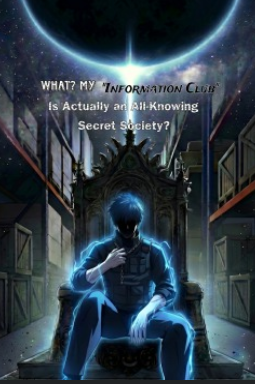
In the burning heat of Jakarta, Arlen is a broke car wash employee with one last hope, his unpublished novel, The Frozen Era. Knowing that nobody reads books anymore, he decides to sell "experience". He makes an Alternate Reality Game (ARG), hiding impossible puzzles across the website, application, and even real life place on another city, to find the smartest readers for his story about a tropical apocalypse. He expected to find bored gamers, employee, or maybe some broke people like him. Instead, he recruited a group of dangerous strangers. These elite few cracked his codes and entered his secret chat room. They are convinced that Arlen, Known to them only as "The Architect", is not a fiction writer, but a whistleblower leaking secret information from the future, about the end of the world. Then, the terrifying coincidence begins. Whatever Arlen writes in the chat, suddenly all his followers find a way to justify the reality to it. To Arlen, it is just incredible luck for his marketing campaign. But while he sits in his apartment celebrating his "success," his followers are emptying their bank accounts, building bunkers, and preparing for the end of the world. The heat is a lie. The ice is coming. And the only person who thinks it’s all fake... is the one who wrote the script.
One-Sentence Positioning:
What? My “Information Club” is Actually an All-Knowing Secret Society? is a razor-edged misunderstanding comedy where a broke Indonesian writer accidentally becomes the messiah of an apocalypse cult he thought was just a marketing campaign.
Who This Is For:
This is for readers who love hidden-mastermind stories, accidental cult-leader comedy, modern apocalypse fiction, ARG conspiracies, secret chat rooms, and protagonists who win not because they understand the situation, but because everyone else misunderstands them with terrifying confidence.
It is also for readers who enjoy web novels that turn internet culture into plot fuel. The story understands how online communities mythologize fragments of information, how desperate people project meaning onto ambiguity, and how a man trying to sell fiction can accidentally manufacture belief. If you like stories where comedy and dread are not opposites but co-conspirators, this one has a very specific and addictive flavor.
Who This Is Not For:
This is not for readers who dislike misunderstanding-driven plots. If you need the protagonist to be fully in control, constantly competent, and aware of the scale of his influence, the central joke may frustrate you. The entire engine of the story runs on dramatic irony: Arlen thinks he is running a clever little promotional game, while his followers treat every vague hint like classified prophecy.
It is also not ideal for readers who want grounded realism all the way through. The premise is deliberately absurd, and its pleasure comes from watching coincidence, paranoia, and online overinterpretation escalate into something much larger than one broke man ever intended.
3 Reasons to Recommend:
It weaponizes the “accidental mastermind” trope better than most stories in the genre.
A lot of misunderstanding comedies become stale because the protagonist’s ignorance is too convenient. Here, the setup is sharper: Arlen is not pretending to be a godlike strategist for vanity. He is trying to sell his unpublished novel in a world where nobody reads. That detail gives the comedy a cruel little economic bite. He is not a chosen one. He is a broke creative trying to survive the attention economy.
That makes his transformation into “The Architect” both hilarious and unsettling. His followers do not simply misunderstand him because they are stupid; they misunderstand him because the world has primed them to search for patterns, secrets, leaks, and hidden authorities. The joke lands because it feels contemporary. We live in an era where a cryptic post, a fake puzzle, or a half-coherent theory can become a movement overnight. This novel takes that cultural sickness and turns it into narrative momentum.
The apocalypse angle gives the comedy real stakes.
The best thing about this story is that it is not merely “haha, everyone thinks the protagonist is smart.” The misunderstanding is funny, but the consequences are not harmless. People start preparing for the end of the world. They empty bank accounts. They build bunkers. They reorganize their lives around a fiction that may, through terrifying coincidence, be brushing against truth.
That is where the book becomes more interesting than a simple gag serial. Arlen’s fake authority begins to produce real-world consequences, and the gap between intention and impact becomes the story’s pressure point. He thinks he is marketing. They think he is warning them. The reader is trapped between laughing at the absurdity and noticing that belief, once organized, becomes power.
Arlen is compelling because he is pathetic in a very modern way.
Arlen’s poverty is not decorative. His desperation matters. He is not a suave manipulator sitting in a tower and moving pieces across a board. He is a man with a failed dream, a clever idea, and no real understanding of the monster he has built. That makes him funnier, but also more human.
There is something brutally relatable about a writer creating an elaborate interactive experience just to find readers, only to discover that people are far more willing to believe in conspiracy than literature. That is the novel’s bleakest joke, and maybe its smartest one. Arlen cannot sell a story as a story. But package it as forbidden knowledge, future intelligence, and secret truth? Suddenly everyone listens.
1 Turn-Off Point:
The same misunderstanding engine that makes the novel addictive can also become its biggest liability. If the story stretches Arlen’s ignorance too long, or if every coincidence bends too neatly in his favor, the tension risks turning into formula. The premise works best when the comedy feels like a trap tightening around him, not a cheat code protecting him.
The novel has to keep balancing three forces: absurdity, paranoia, and consequence. Too much absurdity, and the apocalypse loses weight. Too much consequence, and the comedy curdles. Too much coincidence, and Arlen stops feeling lucky and starts feeling algorithmically blessed. When the balance holds, the story is electric. When it wobbles, readers may begin to feel the machinery behind the miracle.
Editor’s Comment:
What? My “Information Club” is Actually an All-Knowing Secret Society? has the kind of title that sounds like disposable gimmick fiction, which makes it easy to underestimate. That would be a mistake. Under the long, ridiculous title is a surprisingly sharp story about narrative authority: who gets believed, why they get believed, and what happens when fiction becomes more useful to people than reality.
The genius of the premise is that Arlen is not actually all-knowing. He is not a secret prophet. He is not the head of a vast organization. He is a broke man in Jakarta trying to turn his novel into an experience because ordinary publication has failed him. But that failure is exactly what makes the book interesting. In a healthier world, Arlen might have been a writer with a niche audience. In this world, he becomes an accidental oracle because people no longer want stories. They want coordinates. They want codes. They want someone to tell them the disaster has meaning.
That is the novel’s most vicious little insight. The “Information Club” is funny because it is built on a mistake, but it is disturbing because the mistake fulfills a need. The followers need The Architect to be real. They need the puzzle to point somewhere. They need the coming ice, the hidden signals, the impossible patterns, and the secret society to explain why the world feels like it is already ending.
Arlen, meanwhile, is stuck in the most writerly hell imaginable: people are finally obsessed with his work, but only because they refuse to understand it as fiction.
This is why the novel’s comedy has teeth. It is not just laughing at gullible followers or at Arlen’s panic. It is laughing at a culture where marketing, conspiracy, fandom, survivalism, and spiritual hunger all blur together. The secret chat room becomes a church. The ARG becomes scripture. The author becomes a prophet precisely because he never asked to be one.
As a reading experience, it is chaotic, clever, and often very funny. It has the momentum of a web serial that knows its hook and keeps feeding it with bigger misunderstandings, stranger consequences, and a widening cast of believers who turn Arlen’s accidental persona into something almost institutional. The danger, of course, is repetition. A premise this dependent on dramatic irony has to evolve or it will eventually flatten. The story needs to keep asking harder questions: when does a lie become leadership? When does accidental influence become responsibility? And at what point does Arlen stop being innocent simply because he did not mean for any of this to happen?
That is where the book has the potential to become more than a good gimmick. Its funniest idea is that a failed writer becomes an apocalypse cult’s intellectual center. Its best idea is that belief does not care whether the author is ready for it.
For readers who enjoy accidental mastermind stories, this is absolutely worth trying. It is witty, strange, culturally current, and much sharper than its joke-title suggests. It is not polished in the sterile, literary-magazine sense, and it should not be. Its energy comes from online paranoia, broke-artist desperation, and the terrifying speed with which a good story can become a bad religion.
At its best, What? My “Information Club” is Actually an All-Knowing Secret Society? feels less like a simple comedy and more like a satire of the modern internet’s deepest hunger: not for truth, exactly, but for someone confident enough to pretend the chaos has a plan.




 千斤顶
千斤顶









 English
 简体中文
简体中文 繁體中文
繁體中文 한국 사람
한국 사람 日本語
日本語 Deutsch
 русский
 بالعربية
 TÜRKÇE
 português
 คนไทย
คนไทย french