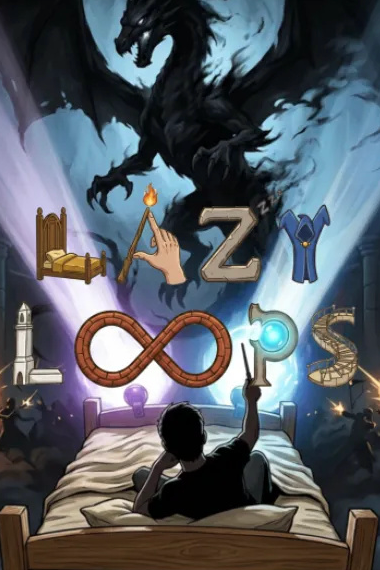
The harder you try, the faster you die. Lazlo Yarrow is the most naturally gifted mage at MIRKS, the most prestigious magic school in the land. He is also the laziest mage. He enchanted his boots to fly so he wouldn’t have to walk to class. He invented a spell to hold his eyes open during lectures so he could sleep without getting caught. His spells never fail, but he never puts in more effort than needed. Effort killed his parents. They worked the mana-factories of Kratos until their mana channels burned out, and Lazlo learned the only lesson that mattered: never try hard enough to break. Then a dragon attacks his school. People are slaughtered. The academy falls apart. And Lazlo finds his uncle, Headmaster Corwen Yarrow, dying from the same mana exhaustion that took his parents. Lazlo casts one desperate spell to save his uncle.
Lazy Loops is a deceptively clever magic-school time-loop LitRPG about a prodigy who calls himself lazy, but whose real superpower is turning trauma, optimization, and avoidance into a brutally efficient path toward becoming an archmage.
Who This Book Is For
This is for readers who like progression fantasy with a brain behind the numbers. If you enjoy magic academies, time-loop problem solving, snarky protagonists, incremental power growth, and systems that promise long-term mechanical payoff rather than instant dopamine, Lazy Loops is very much in your lane.
It is especially suited to readers who understand that “lazy” does not always mean stupid, passive, or useless. Lazlo Yarrow is not simply a slacker gag stretched into a protagonist. He is a brilliant young mage who has built an entire personality around avoiding effort because effort, in his world, has a body count. His parents died from mana exhaustion. His uncle collapses under the same brutal logic. So when Lazlo refuses to “try hard,” the novel is not merely playing for laughs. It is turning a meme into a wound.
Readers who like The Perfect Run-style loop logic, academy politics, practical spellcraft, and protagonists who solve problems sideways rather than heroically charging forward will probably find a lot to enjoy here. The book also has the clean, reader-friendly momentum Royal Road audiences tend to reward: a strong hook, a readable voice, clear genre promises, and enough character banter to keep the mechanical side from drying out.
Who This Book Is Not For
This is not for readers who need the premise to pay out instantly. Despite the title, the early stretch spends a surprising amount of time establishing Lazlo, MIRKS, the academy hierarchy, the dragon disaster, and the emotional engine behind the loop before fully becoming the “idle time-loop optimization machine” some readers may expect from the packaging.
It is also not for readers who dislike talkative, evasive, performatively unserious protagonists. Lazlo’s laziness is intentionally slippery: sometimes a joke, sometimes a shield, sometimes a tactic, sometimes plain avoidance. That layered approach is the book’s strongest character idea, but it is also the main reason some readers will bounce off him. If you want a disciplined grind-monster who immediately starts farming stats with monk-like focus, Lazlo may feel less like a hero and more like a frustrating roommate with apocalyptic consequences.
Three Reasons to Recommend It
First, it makes “laziness” thematically useful instead of treating it as a cheap gimmick.
The smartest thing Lazy Loops does is understand that laziness can be a philosophy of damage control. Lazlo is not lazy because the author needed a funny trait. He is lazy because the world has taught him that ambition burns people out, literally. Mana exhaustion is not just backstory; it is the moral weather of the novel. His refusal to overextend himself is cowardice, comedy, trauma response, and genius all at once.
That tension gives the book more bite than the average “overpowered academy mage” setup. Lazlo’s laziness is not always admirable. Sometimes it is selfish. Sometimes it is obnoxious. Sometimes it is genuinely efficient. The fun lies in watching the novel refuse to fully resolve that contradiction. He is not a secret saint pretending to be useless, and he is not a useless brat accidentally becoming powerful. He is something messier: a gifted young man who has confused self-preservation with identity.
That makes the time loop premise feel unusually appropriate. A loop is the perfect prison for someone who wants the shortest path through everything. Lazlo is forced into the ultimate optimization problem: how do you save people without becoming the kind of person who destroys himself through effort?
Second, the book’s best genre move is combining time-loop structure with idle-game logic.
Time-loop fiction is often about experimentation: try, fail, reset, exploit knowledge, improve the run. Idle games are about accumulation: passive bonuses, scaling systems, long-term efficiency, and rewards that compound while the player appears to be doing very little. Lazy Loops sits at the intersection of those two fantasies, and that is where its commercial hook becomes genuinely interesting.
The book’s promise is not just “a mage gets stronger.” It is “a mage tries to automate the cost of becoming stronger.” That distinction matters. Lazlo is not naturally suited to heroic training arcs. He does not want to sweat through a montage. He wants a workaround. He wants the spell equivalent of a machine that keeps leveling while he naps. In a genre often obsessed with effort as virtue, this is refreshingly perverse.
The result is a progression fantasy that asks a funny but surprisingly sharp question: if hard work is lethal, immoral, or just badly designed, is laziness actually a form of intelligence?
Third, Lazlo has enough personality to survive the trope pile.
On paper, the ingredients are familiar: prodigy mage, prestigious academy, catastrophic attack, dying mentor, time loop, eventual overpowered growth. A lazier book would coast on those tags. Lazy Loops works because Lazlo has a voice. He is cheeky, defensive, self-justifying, clever, and more emotionally transparent than he wants to be. The reader can see the gap between what he says and what he is.
Several early readers have picked up on exactly this point: Lazlo’s laziness is not a flat archetype but a mask. That matters because it gives the humor a pressure point. His jokes are funny, but they are also evasions. His shortcuts are clever, but they are also attempts to avoid confronting grief, responsibility, and fear. The book is at its strongest when it lets Lazlo be irritating without asking the reader to mistake irritation for bad writing.
The supporting cast also helps. Readers have singled out the character dynamics, especially the early friendship beats, as a major draw. The academy setting is not merely wallpaper; it gives Lazlo foils, social friction, hierarchy, and a structure for the coming loops to break and reconfigure.
One Reason to Hesitate
The title sells “Idle LitRPG” and “time loop,” but the opening may feel slower than that pitch suggests.
This is the central risk. The book begins with a strong disaster setup and a lot of character groundwork, but readers arriving for immediate loop abuse, passive-scaling mechanics, and crunchy idle progression may feel the early chapters are still winding the machine rather than letting it run. Some reviewers have already expressed frustration that the “idle” and “loop” elements take time to fully click into place.
That is not necessarily a flaw, but it is a marketing tension. The book wants to be both a character-driven academy story and an optimization fantasy. When those two engines align, it sings. When they do not, impatient readers may feel they were promised a calculator and handed a trauma-informed school novel with jokes.
Editor’s Review
Lazy Loops is one of those Royal Road serials whose premise sounds like a joke until you notice the joke has teeth. “Lazy mage stuck in a time loop” could have been disposable wish fulfillment. Instead, Fiddlesoup builds the idea around a quietly nasty insight: Lazlo lives in a world where effort is not inspirational. Effort is industrial. Effort is extractive. Effort killed his parents.
That gives the story its edge. The novel’s most interesting conflict is not Lazlo versus the dragon, or Lazlo versus the academy, or even Lazlo versus the loop. It is Lazlo versus the moral mythology of progression fantasy itself. Most LitRPGs worship the grind. Lazy Loops side-eyes it. What if grinding is just another word for letting a system consume you? What if the smartest protagonist is not the one who works hardest, but the one who designs a way not to?
This is where the book feels freshest. Its concept turns laziness into an ethic of optimization. Lazlo’s dream is not weakness; it is automation. He wants power without self-destruction. He wants competence without martyrdom. He wants to save people without becoming another burned-out corpse in the machinery of magic. That is both funny and weirdly contemporary.
The prose, based on early reception, is one of the book’s clear strengths: clean, readable, quick with banter, and confident enough to let scenes breathe. The character writing is also doing more work than the blurb initially suggests. Lazlo’s contradictions are the point. He says he is lazy, then acts when it matters. He avoids effort, then invents elaborate solutions. He performs indifference, then reveals attachment. This is not always smooth, and some readers will understandably call it inconsistency. But the more generous and, I think, more interesting reading is that Lazlo is a young man using laziness as armor.
Still, the novel is not immune to its own branding. “Idle LitRPG” creates expectations, and expectations are dangerous in a serial marketplace. If the early chapters delay the full loop-and-idle payoff for too long, some readers will feel misled. The book’s defenders will call that patient setup; its critics will call it a bait-and-switch. Both reactions make sense. The question is whether readers are willing to treat the opening as character investment rather than delayed gratification.
My sharper verdict: Lazy Loops is not yet a flawless machine, but it is already a distinctive one. It has a protagonist with a real psychological angle, a premise with strong mechanical potential, and a thematic argument hiding under the jokes. It understands that the funniest kind of laziness is not doing nothing. It is doing one impossibly clever thing so you never have to do the stupid thing again.
For a young ongoing serial, that is more than a good start. It is a promise worth watching.




 千斤顶
千斤顶









 English
 简体中文
简体中文 繁體中文
繁體中文 한국 사람
한국 사람 日本語
日本語 Deutsch
 русский
 بالعربية
 TÜRKÇE
 português
 คนไทย
คนไทย french