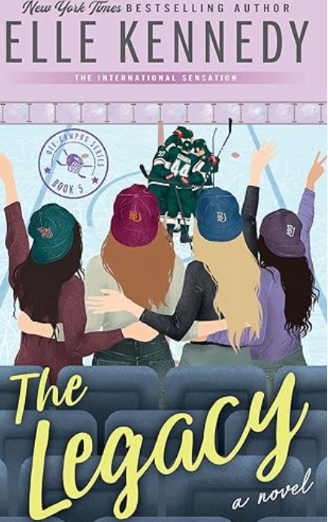
Four stories. Four couples. Three years of real life after graduation… A wedding. A proposal. An elopement. And a surprise pregnancy. Life after college for Garrett and Hannah, Logan and Grace, Dean and Allie, and Tucker and Sabrina, isn't quite what they imagined it would be. Sure, they have each other, but they also have real-life problems that four years at Briar U didn't exactly prepare them for. As it turns out, for these four couples, love is the easy part. Growing up is a whole lot harder. Come for the drama, stay for the laughs! Catch up with your favorite Off-Campus characters as they navigate the changes that come with growing up and discover that big decisions can have big consequences…and big rewards.
The Legacy is less a fifth Off-Campus romance than an extended postscript in which four beloved couples discover that winning the love story was easy compared with building a life sturdy enough to survive careers, marriage, parenthood, family trauma and the terrifying possibility of becoming ordinary.
WHO THIS BOOK IS FOR
The Legacy is written first and foremost for readers who already love the original Off-Campus couples and are emotionally invested in what happened after graduation.
It is ideal for readers who finished The Deal, The Mistake, The Score and The Goal wishing for more than a brief epilogue. Instead of introducing a new central romance, Elle Kennedy returns to Garrett and Hannah, Logan and Grace, Dean and Allie, and Tucker and Sabrina several years later, when the adrenaline of first love has been replaced by adult logistics.
This is a strong fit for fans of ensemble casts, domestic romance, relationship-in-progress stories and affectionate friend-group chaos. The pleasure comes from recognizing old dynamics in altered circumstances: the jokes are familiar, the friendships remain loud and intrusive, but the problems are no longer confined to college parties, hockey games and academic deadlines.
Readers who enjoy weddings, proposals, surprise pregnancies, career dilemmas, domestic negotiations and established couples learning how to remain interesting after the chase is over will find plenty to enjoy.
It also works well for romance readers who appreciate a reunion special more than a tightly engineered sequel. The four-novella format resembles a television cast returning for a holiday episode: not every storyline is equally substantial, continuity and emotional payoff matter more than novelty, and much of the experience depends on affection carried over from earlier installments.
Most importantly, this book is for readers who do not consider happiness the end of a story. The Legacy asks what happens when romance stops being an escape from adulthood and becomes one of adulthood’s central responsibilities.
WHO THIS BOOK IS NOT FOR
This is not a suitable entry point for readers new to the Off-Campus series.
Although each section contains enough context to make the basic situation understandable, the book depends heavily on emotional memory. A proposal matters because readers remember how the couple began. A pregnancy carries weight because they understand the characters’ histories. A casual group scene becomes funny because the friendships have been built across four previous books.
Without that investment, The Legacy can feel like arriving late to a reunion where everyone else already knows the stories.
It is also unlikely to satisfy readers seeking a fully developed new romance, a major hockey narrative or a single continuous plot. The book contains four interconnected novellas rather than one traditionally structured novel. Each section must reintroduce a couple, establish an adult problem and reach an emotional resolution within limited space.
That compression creates unevenness. Some conflicts feel organically connected to the characters’ histories; others feel imposed because a novella about an already-happy couple still needs something to go wrong.
Readers who dislike pregnancy plots, marriage-centered endings or the assumption that adult fulfillment naturally moves toward weddings and children may also struggle with the book. Kennedy does not give every couple exactly the same future, but the collection remains heavily invested in conventional romantic milestones.
Finally, readers protective of the original novels may find certain choices frustrating. The Legacy occasionally destabilizes relationships that previously seemed secure, and not every reader will agree that the new conflicts deepen the couples. In some cases, they may seem to make familiar characters behave less maturely simply to generate a plot.
THREE REASONS TO RECOMMEND IT
1. IT TAKES THE HAPPILY-EVER-AFTER SERIOUSLY ENOUGH TO MAKE IT UNCOMFORTABLE
Most romance novels end at the moment of maximum certainty.
The couple has confessed their love, resolved the central misunderstanding and chosen a shared future. The genre’s emotional contract allows the reader to leave before that future becomes mundane, before desire has to coexist with scheduling, money, work, grief, fertility, family obligations and dirty dishes.
The Legacy deliberately enters that less glamorous territory.
Its most interesting idea is stated plainly in the premise: love is the easy part; growing up is harder. That could have become a sentimental slogan, but the four-story format allows Kennedy to test it in several different relationships.
The couples do not doubt that they love one another. Their problems come from disagreeing about what love should require.
Should commitment be demonstrated through marriage, or can demanding marriage become a refusal to hear a partner’s boundaries? Should a couple pursue a carefully planned future, or accept that adulthood is largely an accumulation of unplanned consequences? How much emotional damage can one partner carry before the other is affected by its weight? At what point does support become pressure?
These are not the same questions the characters faced in college. Their original books were concerned with trust, attraction, self-worth and the courage to choose intimacy. The Legacy is concerned with maintenance.
That shift is valuable because established relationships are often underserved in popular romance. Once sexual and emotional certainty have been achieved, fictional couples are usually removed from the stage. Kennedy instead treats continuation as its own dramatic condition.
The results are not always flattering. Characters readers once experienced as charmingly impulsive can seem exhausting when impulsiveness affects mortgages, weddings or children. A grand gesture that worked in a college romance may become manipulative when one partner has explicitly asked for time.
This discomfort is part of the book’s value, even when the execution is debatable. The collection reminds us that personal traits do not disappear when a relationship becomes official. Confidence can harden into entitlement. Loyalty can become avoidance. Protectiveness can conceal unresolved fear. Romantic spontaneity can create practical chaos for someone else.
The Legacy is therefore not simply fan service. At its best, it is a stress test applied to four fantasies that once seemed complete.
2. THE FRIEND GROUP REMAINS THE SERIES’ MOST CONVINCING LOVE STORY
The romantic couples provide the structure, but the friendships provide the book’s emotional continuity.
One of Kennedy’s strengths throughout Off-Campus has been her ability to create a social world that feels inhabited beyond the central pairing. The characters interfere, mock, advise, gossip and appear at exactly the wrong moment. Their intimacy is rarely solemn, but it is persistent.
The Legacy benefits enormously from this accumulated chemistry.
Because the book moves between four couples, characters who were once protagonists become supporting players in one another’s lives. This creates the satisfying sense that the series has continued even when the reader was not watching. They know one another’s histories, recognize recurring mistakes and carry memories that no single romantic partner possesses.
The absurd recurring thread involving the unwanted doll Alexander is the clearest example of Kennedy’s comic instincts. On the surface, it is little more than an extended prank: a creepy object repeatedly passed among friends who are desperate to get rid of it.
Yet the joke performs an important structural function. It travels across the four novellas, binding them together and preventing the collection from feeling like four unrelated bonus chapters. Alexander becomes a ridiculous physical symbol of the group’s refusal to leave one another alone.
More seriously, the friendships create a form of emotional accountability. Romantic partners can become trapped inside a private interpretation of a conflict. Friends see the relationship from outside, sometimes more clearly and sometimes with spectacular incompetence.
This communal quality distinguishes Off-Campus from romances in which the couple exists in an emotional vacuum. Garrett and Hannah, Logan and Grace, Dean and Allie, and Tucker and Sabrina have built not only individual partnerships but a small social institution.
The book understands that growing up often threatens friendship as much as romance. Careers, geography, weddings and children reorganize time. People who once lived within walking distance must now actively decide whether closeness remains a priority.
The collection’s warmest achievement is its insistence that friendship does not have to become a casualty of adulthood. It changes shape, becomes harder to schedule and occasionally manifests as a cursed porcelain doll, but it remains part of the characters’ definition of home.
3. GARRETT AND HANNAH’S STORY GIVES THE COLLECTION ITS NECESSARY EMOTIONAL WEIGHT
Much of The Legacy is playful, romantic and intentionally indulgent. Garrett and Hannah’s section complicates that tone by returning to trauma that love did not magically erase.
Garrett’s relationship with his abusive father was one of the most serious elements of The Deal. Revisiting that history prevents the collection from presenting adulthood as a parade of celebratory milestones. Some legacies are not inheritances anyone wants.
The title therefore operates on two levels.
There is the pleasant legacy of the series itself: beloved couples, private jokes, friendships and the future readers hoped these characters would receive. But there is also the darker legacy of family violence, expectation and fear. Garrett has escaped his father’s control, yet escape is not the same as emotional freedom.
This storyline is important because romance narratives sometimes imply that finding the right partner permanently resolves old wounds. Hannah’s love gives Garrett support, safety and a different model of intimacy. It cannot retroactively give him a different childhood.
The novella explores the uncomfortable reality that trauma can return even after years of apparent stability. A person can be successful, loved and outwardly secure while still reacting to an abusive parent from the emotional position of a frightened child.
Hannah’s role is equally significant. She loves Garrett, but love does not grant her unlimited power over his recovery. She cannot force him to grieve correctly, speak before he is ready or transform his pain into a clean narrative of closure.
The strongest moments recognize that partnership means witnessing wounds one cannot repair.
This gives the collection a seriousness it otherwise might lack. Weddings and pregnancy announcements look toward the future; Garrett’s story asks what part of the past will be carried into that future, whether consciously or not.
There is also an implicit challenge to the conventional masculine ideal surrounding sports romance. Garrett has been defined by physical strength, athletic competence and charisma. His father’s reappearance exposes the limits of those qualities. He cannot outplay, overpower or joke his way out of inherited damage.
The storyline does not always have enough space to explore these questions fully, but it gives The Legacy its most meaningful argument: adulthood is not the moment when the past stops mattering. It is the moment when people become responsible for deciding what the past will be allowed to reproduce.
ONE REASON TO SKIP IT
SOME OF THE CONFLICTS FEEL LESS LIKE CHARACTER DEVELOPMENT THAN CHARACTER REGRESSION
The most common criticism of The Legacy is also the most persuasive: several novellas create drama by making established couples temporarily worse at communicating than readers expect them to be.
Dean and Allie’s storyline is the clearest example.
Allie expresses hesitation about engagement, while Dean becomes fixated on proposing. The story is intended to explore the difference between being committed to a person and being ready for a particular institution or timeline.
That is a worthwhile conflict. The difficulty is that Dean’s persistence can read less like romantic certainty and more like disregard for Allie’s stated boundaries.
In a new romance, a misguided grand gesture may be corrected as part of the hero’s emotional education. In an established relationship, the same behavior raises a sharper question: after years together, why is he still listening so selectively?
The novella eventually moves toward reassurance and resolution, but some readers may feel that it rewards pressure rather than fully interrogating it.
Other sections rely on similarly familiar devices: withheld fears, poorly timed conversations, unexpected reproductive developments and decisions made without adequate discussion. These are plausible sources of adult conflict, but the limited novella length means the characters sometimes move from stability to crisis before the psychological transition has been fully established.
This is the danger of returning to a completed romance.
Readers remember the original ending as proof that the couple learned something fundamental. A sequel that reopens those issues must demonstrate why the earlier growth was incomplete. Otherwise, new conflict can feel like the author repossessing emotional maturity simply because a story requires complications.
The Legacy does not consistently clear that bar.
For some readers, seeing favorite characters imperfect, anxious and occasionally selfish will make them feel more human. For others, it will contaminate endings they preferred to imagine for themselves.
Anyone who strongly values the emotional closure of the original four books should approach this collection with caution. It offers more time with the characters, but more time inevitably means more opportunities for them to disappoint you.
EDITOR’S VERDICT
The Legacy poses a question most romance series avoid: once readers have been promised forever, what exactly are they imagining?
“Forever” is emotionally persuasive because it remains abstract. It contains no calendar, no budget, no fertility decisions, no relocation arguments and no traumatic phone calls. It is a word large enough to hold every hope while excluding most practical detail.
This collection gives forever a schedule.
Garrett and Hannah, Logan and Grace, Dean and Allie, and Tucker and Sabrina are still in love, but love is no longer the decisive event of their lives. It is the environment in which all other decisions must now be made.
That distinction gives The Legacy more depth than its fan-service packaging suggests.
The book is marketed through recognizable rewards: a wedding, a proposal, an elopement and a surprise pregnancy. These are familiar romance milestones, almost a checklist of genre closure. Kennedy’s more interesting move is to show that each milestone can produce anxiety as easily as happiness.
Marriage is not merely proof of love; it is a negotiation over timing, autonomy, family and symbolism. Pregnancy is not merely a sentimental epilogue; it reorganizes identity and future plans. Success does not eliminate insecurity. Distance does not become painless because a couple has survived it before.
The collection also exposes a tension at the heart of sequel culture.
Readers ask to revisit beloved characters because they want confirmation that the original happiness lasted. But a story requires change, uncertainty and friction. The author must therefore preserve the fantasy while threatening it just enough to justify the return.
The Legacy sometimes resolves this problem elegantly and sometimes too visibly manufactures a crisis.
Its best sections understand that happiness can generate new fears without invalidating old growth. The more a person has built, the more there is to lose. Commitment does not eliminate vulnerability; it increases the number of places where vulnerability can enter.
Its weaker sections mistake conflict for depth. A character ignores a clear boundary, conceals information or reverts to an old pattern, and the narrative relies on the reader’s affection to smooth over the resulting discomfort.
That unevenness helps explain why reactions to the book are so divided. The collection provides exactly what many fans wanted—more time, more banter, more intimacy and concrete answers about the couples’ futures. Yet it also gives readers information they may not have wanted.
An imagined happily-ever-after is perfectly customized by the reader. A written one belongs to the author.
The four-novella structure intensifies this problem because the couples receive unequal emotional material. Some stories feel like meaningful continuations; others resemble extended bonus scenes. Some conflicts reveal how adulthood has changed the characters; others seem arranged around the promised wedding, proposal, elopement or pregnancy.
As a unified novel, The Legacy is loose. As a reunion, it is affectionate and often irresistible.
Kennedy retains her talent for fast dialogue, group chemistry and characters who use humor as both intimacy and defense. The banter remains easy to read because it grows from established relationships rather than interchangeable one-liners. Even when the plots feel contrived, the characters’ pleasure in one another often feels genuine.
The recurring doll subplot is ridiculous, but its ridiculousness is thematically appropriate. Alexander is an unwanted object that keeps returning, passed from one household to another no matter how decisively someone tries to remove it.
In a collection about legacy, the joke almost becomes accidentally profound.
A legacy is what continues to arrive after people believe they have moved on. Sometimes it is love, friendship and shared memory. Sometimes it is trauma, expectation or fear. Sometimes it is an appalling doll in a package with your address on it.
The characters cannot choose everything that follows them into adulthood. They can choose what they pass onward.
That is the collection’s most valuable idea, especially in Garrett’s storyline. Growing up is not simply achieving independence. It is recognizing which inherited behaviors, beliefs and wounds are still making decisions through you.
The Legacy is therefore both satisfying and destabilizing. It confirms that the couples stayed together, but it refuses to preserve them in the amber of their original endings. They become older without always becoming wiser. They make decisions that are loving, foolish, generous, self-protective and occasionally infuriating.
This is more honest than an uninterrupted victory lap, though not always more pleasurable.
Readers looking for the emotional completeness of The Deal or the momentum of a full-length standalone romance will likely find this book secondary. It does not possess the same narrative urgency because its central question is never truly whether the couples will remain together. The outcomes are embedded in the form.
Its suspense lies in how these people will learn to inhabit the futures they once wanted.
For longtime fans, that may be enough. The collection delivers warmth, sexual chemistry, friendship, domestic chaos and the reassuring sense that the doors to the Off-Campus world never fully closed.
For more critical readers, it also offers an intriguing lesson about continuation: every epilogue becomes complicated when allowed to keep living.
The Legacy is not the strongest book in the series, nor is it designed to be. It is a generous, messy appendix that occasionally reveals more about the limits of the happily-ever-after than a cleaner sequel would dare.
EDITORIAL RATING: 3.8/5
An affectionate and uneven reunion that succeeds as emotional fan service, falters when it manufactures conflict, and ultimately proves that staying in love requires a different kind of courage from falling into it.




 千斤顶
千斤顶









 English
 简体中文
简体中文 繁體中文
繁體中文 한국 사람
한국 사람 日本語
日本語 Deutsch
 русский
 بالعربية
 TÜRKÇE
 português
 คนไทย
คนไทย french