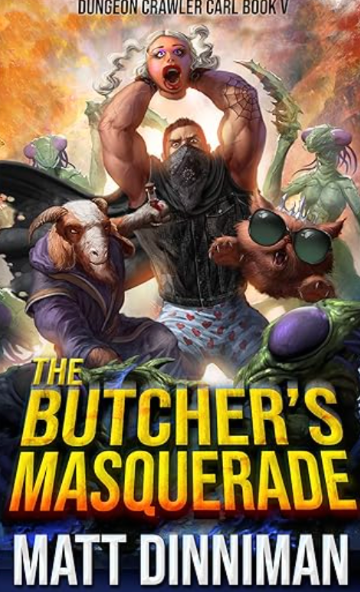
A lush jungle teeming with danger. Savage dinosaurs seeking blood. A fallen princess intent on vengeance. A mysterious, end-of-floor celebration for the top crawlers, dubbed “The Butcher’s Masquerade.” The sixth floor. The Hunting Grounds. As the remaining crawlers battle for their lives, a new, terrible threat looms. Outside tourists are finally allowed to enter the game, and they are here and ready to hunt. Among them is Vrah, a famed and veteran hunter, intent on collecting the biggest trophy of her career. But their prey is far from harmless, and this season they are fighting back. Dungeon Crawler Carl and Princess Donut return in book five of the acclaimed litrpg series.
The Butcher’s Masquerade is the volume where Dungeon Crawler Carl stops being merely an exceptionally funny survival LitRPG and reveals itself as a furious political satire about audiences who purchase suffering, institutions that monetize resistance, and survivors forced to turn their trauma into entertainment.
Who This Book Is For
This book is for readers who already enjoy Dungeon Crawler Carl’s improbable mixture of game mechanics, ultraviolence, absurdist comedy, emotional damage, and a talking Persian cat with the instincts of both a pageant queen and a revolutionary propagandist.
It is particularly well suited to readers who want LitRPG systems to carry thematic weight rather than function as decorative spreadsheets. Levels, loot boxes, sponsorship deals, ratings, achievements, audience polls, class abilities, and dungeon rules are not separate from the novel’s social critique. They are the machinery through which suffering is packaged, priced, and sold.
The book will also appeal to readers who enjoy protagonists becoming politically dangerous without suddenly becoming politically sophisticated. Carl is increasingly capable of damaging the system, but he does not possess a clean ideology or master plan. He remains a furious, exhausted man attempting to save the people near him while gradually recognizing that survival itself has become a form of collaboration with the show.
Fans of large-scale tactical payoffs should find plenty to enjoy. The sixth floor is an enormous hunting ground populated by dinosaurs, hostile crawlers, rival factions, tourists, sponsors, monsters, quests, traps, and layered rules that Carl repeatedly tries to weaponize against their creators.
Most importantly, this is for readers who like comedy that does not protect them from grief. The jokes remain obscene, ridiculous, and frequently brilliant, but by the fifth volume humor has become less an escape from horror than one of the characters’ survival responses to it.
Who This Book Is Not For
This is not an entry point for new readers.
The Butcher’s Masquerade assumes familiarity with four previous books’ worth of characters, grudges, abilities, political arrangements, traumas, running jokes, sponsors, celestial powers, dungeon mechanics, and unresolved emotional conflicts. Beginning here would be like arriving during the fifth act of a very violent opera and attempting to identify the cast from their weapons.
It is also unlikely to work for readers who dislike long, mechanically dense action sequences. Matt Dinniman generally makes rules entertaining, but the sixth floor contains an enormous quantity of moving parts. Skills, cooldowns, traps, factions, temporary alliances, magical exceptions, inventory decisions, and spatial logistics can become exhausting even when the plot remains fast.
Readers uncomfortable with graphic violence, sexualized absurdity, animal danger, addiction, cruelty, grief, body horror, or jokes delivered at moments of extreme suffering should approach cautiously. The series deliberately refuses the idea that humor and horror must take turns. They frequently occupy the same sentence.
Finally, readers who require elegant restraint may find the book aggressively excessive. The Butcher’s Masquerade does not make one monster attack when it can stage a dinosaur stampede, a corporate hunting holiday, a revenge plot, a magical ball, a political uprising, and an emotionally devastating betrayal inside the same narrative structure.
Three Reasons to Recommend It
Reason One: The Hunter Floor Is the Series’ Sharpest Metaphor for Privileged Violence
The sixth floor changes the moral structure of the dungeon.
Carl and the other crawlers have always been victims of entertainment. Their deaths generate ratings, advertising opportunities, fan engagement, merchandise, political influence, and corporate profit. But on the Hunting Grounds, the audience no longer watches from a safe distance. Wealthy outsiders are permitted to enter the dungeon and personally hunt the surviving humans.
The metaphor is hardly subtle, but subtlety would weaken it.
The hunters represent the final stage of consumer entitlement. Watching suffering is no longer sufficient. They want participation. They want photographs, trophies, status, and the emotional thrill of believing that purchased access makes them courageous.
Their presence transforms the dungeon from a sadistic reality show into a luxury tourism industry built around genocide.
What makes the satire effective is that the hunters do not generally see themselves as villains. They are customers. The system has declared the activity legal, organized, prestigious, and entertaining. Their money has converted atrocity into recreation.
This is how the novel understands institutional evil: not primarily as individual sadism, but as a sequence of transactions that allows everyone involved to rename what they are doing.
The hunters call murder sport.
The corporations call it content.
The audience calls it a season.
The dungeon calls it a floor mechanic.
Carl calls it what it is.
Yet even Carl’s resistance becomes valuable programming. Every rebellion increases his popularity. Every attempt to humiliate the show gives the show another marketable narrative. His rage is clipped, broadcast, discussed, and sold back to the audience as entertainment.
This creates the series’ central trap: Carl cannot resist invisibly.
To gain the resources required to survive, he must become more famous. To become more famous, he must produce better television. To produce better television, he must suffer publicly, behave unpredictably, and remain alive long enough for viewers to form an emotional investment.
The system rewards him for opposing it because opposition is one of its most valuable products.
The Butcher’s Masquerade pushes this contradiction further than the earlier books. Carl begins to understand that killing individual enemies will never be enough. The real opponent is an economic and political structure capable of turning even its own humiliation into revenue.
The book’s most radical idea is therefore not that the prey can fight back.
It is that the prey must learn to make exploitation more expensive than liberation.
Carl’s growing instinct to attack wealth, sponsorship, reputation, contracts, and institutional legitimacy is more dangerous than any increase in his combat statistics. He is gradually learning that when a system values profit above life, the most effective attack may be directed at the profit.
Reason Two: Carl and Donut Have Become One of Fantasy’s Most Convincing Trauma-Bonded Families
The emotional center of the series is no longer the joke that Carl has entered the apocalypse with his ex-girlfriend’s cat.
By The Butcher’s Masquerade, Carl and Princess Donut have become each other’s primary family.
Their relationship works because Dinniman does not sentimentalize it. Carl does not suddenly become verbally expressive, emotionally healthy, or naturally parental. Donut does not stop being vain, theatrical, jealous, impulsive, and obsessed with controlling how others perceive her.
They love each other through habits rather than declarations.
Carl calculates danger around Donut’s survival.
Donut reads shifts in Carl’s emotional state that he believes he has concealed.
He gives her space to perform confidence.
She gives him reasons not to surrender to rage.
They irritate, manipulate, protect, embarrass, and emotionally regulate one another. Their bond is messy enough to feel lived rather than designed.
This volume deepens that relationship by showing how both characters use performance to survive.
Donut’s pageant personality is often treated as comic relief, but it increasingly resembles armor. Her dramatic announcements, capitalization, songs, insults, and insistence on maintaining royal dignity allow her to impose narrative order on experiences that would otherwise overwhelm her.
She cannot control the dungeon, but she can control the performance of Princess Donut.
Carl’s mask is different. He becomes practical, angry, tactical, and relentlessly active. He turns grief into tasks because action prevents him from confronting the scale of what he has lost. Every rescue, bomb, trap, and plan gives him a temporary answer to the unbearable question of why he remains alive when so many others do not.
The novel is particularly perceptive about emotional numbness.
Survivors in the dungeon cannot grieve every death when another attack may occur within minutes. They compress pain into something usable. They joke. They plan. They move. They tell themselves they will feel later.
But “later” keeps being postponed.
This is where the book’s comedy becomes more than tonal contrast. Humor is part of the characters’ emergency psychological infrastructure. A ridiculous joke does not mean the horror has disappeared. It means the horror is so constant that conventional seriousness has become impossible to sustain.
Carl and Donut are funny because they are wounded, not despite being wounded.
The novel also understands that trauma can create intense loyalty without producing healthy communication. Carl withholds information because he believes knowledge will endanger Donut. Donut performs confidence because she fears becoming another burden Carl must carry. Both characters protect each other through behaviors that also isolate them.
Their love is real, but reality does not make it uncomplicated.
That distinction gives the relationship unusual emotional credibility within a genre often more interested in party composition than intimacy.
Reason Three: The Book Turns Game Mechanics into Political Leverage
Many LitRPG novels treat rules as natural laws.
A system exists. The protagonist learns it. Power comes from optimizing within it. The fantasy lies in understanding the rules more effectively than anyone else.
Dungeon Crawler Carl has always been more suspicious.
Its rules were written by corporations, administrators, lawyers, artificial intelligences, sponsors, and political actors. They are not neutral. Every mechanic contains an interest. Every reward directs behavior. Every loophole exists because institutions are complicated, competing, and imperfectly controlled.
Carl’s genius is not that he becomes the strongest player.
It is that he increasingly treats the dungeon as hostile legislation.
He studies wording. He identifies conflicting authorities. He exploits unintended interactions. He turns entertainment requirements against safety protocols, quest design against political control, and audience expectations against corporate management.
The Butcher’s Masquerade contains some of the series’ most satisfying examples of this form of resistance. Carl does not simply defeat enemies through superior statistics. He manipulates conditions until the system is forced to recognize an outcome it was never intended to permit.
This gives the action a legalistic quality.
Every major confrontation is partly a battle over interpretation. What counts as a hunter? Who qualifies as prey? Which faction owns an object? When does a quest begin? What happens when separate rule sets collide? Can the dungeon punish a crawler for doing exactly what its instructions allowed?
The spectacle remains entertaining, but beneath it lies a serious political observation: power often presents its preferences as inevitable rules until someone discovers that the rules contradict one another.
Carl’s resistance grows whenever he stops asking, “How do I win this game?” and begins asking, “Who benefits from defining victory this way?”
That question separates The Butcher’s Masquerade from less ambitious progression fantasy.
Power progression still matters. Loot still matters. Abilities, equipment, levels, and tactical preparation still matter. But they are never the whole story. Carl survives because he understands that a system can be physically overwhelming and administratively fragile at the same time.
He cannot punch the entire galaxy.
He may, however, be able to create a contractual disaster, a ratings catastrophe, a public-relations crisis, a financial loss, or a precedent that terrifies the people above him.
This is rebellion translated into game design.
One Major Reason to Stop Reading
The book’s accumulation of mechanics, characters, plots, and delayed consequences occasionally overwhelms its emotional clarity.
The Butcher’s Masquerade is more than seven hundred pages long, and although it remains remarkably readable, length is not the same thing as balance.
A large portion of the novel is devoted to preparation: mapping the floor, understanding its factions, collecting allies, managing quests, anticipating the hunters, developing traps, navigating personal disputes, and arranging pieces for the inevitable Masquerade.
The result is a tremendous climax, but also a somewhat back-loaded structure. The final movement delivers so many reversals, battles, revelations, deaths, emotional confrontations, and future complications that individual moments struggle for space.
Dinniman’s skill at escalation partly disguises the problem. Each new development is exciting enough to justify immediate attention. But the cumulative rhythm can become numbing: danger, joke, mechanic, plan, reversal, explosion, grief, new mechanic, worse danger.
The reader is given little opportunity to process consequences before the next crisis arrives.
This is particularly noticeable in the treatment of Katia.
Her arc contains material involving identity, addiction, shame, loyalty, manipulation, and a devastating future conflict. Some readers regard the late revelations as brilliantly cruel setup. Others find them insufficiently prepared, as though the story introduces several forms of suffering at once in order to manufacture a later crisis.
Both reactions are understandable.
The twist is effective because it threatens one of the party’s most important relationships and proves the dungeon can weaponize intimacy more efficiently than combat. Yet its intensity risks making Katia feel less like a developing person and more like a container into which the plot deposits future tragedy.
The broader series may eventually justify every choice. Dinniman has repeatedly turned apparently excessive complications into strong later payoffs. But judged as an individual volume, The Butcher’s Masquerade sometimes confuses emotional devastation with emotional development.
Readers who prefer clean architecture, concentrated character arcs, and consequences given time to breathe may find the novel exhilarating but exhausting.
Editor’s Verdict
The Butcher’s Masquerade is the book in which Matt Dinniman’s series fully earns the seriousness hidden beneath its ridiculous surface.
The premise of Dungeon Crawler Carl has always sounded like a dare: Earth is conquered, survivors are forced into a televised dungeon, a barefoot man fights monsters in boxer shorts, and his primary companion is a prize-winning cat named Princess Donut.
The easy version of that concept would have been a parody.
The merely successful version would have been an addictive action comedy.
Dinniman has built something more unsettling: a story about genocide administered as intellectual property.
The dungeon does not merely kill people. It converts their identities into content. It creates heroes, villains, romances, rivalries, tragedies, product opportunities, audience segments, and marketable emotional arcs. Human beings are not only physically trapped; they are narratively owned.
The Butcher’s Masquerade expands that critique by allowing wealthy viewers to cross the boundary between consumption and participation.
This is the logical endpoint of the dungeon’s culture. Once suffering becomes entertainment, the richest audience members will eventually demand premium access to the suffering itself.
The hunters believe their money protects them from consequence. They enter a controlled environment where violence has been licensed, victims have been dehumanized, and corporate rules promise an asymmetrical contest.
Carl’s response is satisfying because he refuses the moral vocabulary of the event.
He does not accept that they are players.
They are invaders.
He does not accept that this is sport.
It is murder.
He does not accept that the system’s permission creates legitimacy.
It creates evidence.
The difference between Carl and a conventional power-fantasy protagonist becomes especially clear here. He does not primarily want to dominate the dungeon. He wants the dungeon to lose its ability to define reality.
That ambition remains partly incoherent. Carl is still reacting more than governing. His rage supplies direction, but not yet a complete political program. He is willing to destroy, expose, humiliate, and sabotage. What should replace the existing order remains uncertain.
This is not a weakness so much as an honest recognition of his position.
Carl is a traumatized survivor inside a machine he barely understands. It would be absurd for him to possess a perfect theory of revolution. His moral clarity comes from immediate experience: people are being tortured, the powerful enjoy it, and the institutions responsible have made reform indistinguishable from public relations.
His politics begin with refusal.
Donut’s politics begin with performance.
She understands instinctively that the dungeon is partly a battle over audience perception. Where Carl wishes to expose the obscenity of the show, Donut knows how to occupy its language. She creates slogans, personas, rivalries, and moments viewers can recognize. She turns celebrity into protection and attention into leverage.
Together, they represent two forms of resistance.
Carl attacks the machine.
Donut hijacks the broadcast.
Neither strategy is sufficient alone. Destruction without narrative control allows the system to label Carl a monster. Performance without physical resistance turns Donut into another profitable mascot. Their partnership works politically for the same reason it works emotionally: each possesses capacities the other lacks.
The novel’s supporting cast makes this emerging movement feel larger than a single hero. Katia, Mordecai, Mongo, Prepotente, Samantha, and the other crawlers are not merely party members waiting to contribute abilities during combat. They represent competing survival responses.
Some characters seek revenge.
Some seek community.
Some attempt to preserve ordinary morality.
Some accept that ordinary morality cannot survive the dungeon unchanged.
Some believe visibility is protection.
Others understand that visibility paints a target.
The series becomes richer as these strategies conflict.
The sixth floor also sharpens a moral problem that the books cannot avoid forever: the status of non-crawler beings inside the dungeon.
The system creates, copies, manipulates, resurrects, repurposes, or imprisons countless apparent people. Some are treated as enemies, some as allies, some as quest mechanisms, and some as disposable scenery. Carl increasingly recognizes their personhood, but the action structure still requires him to kill enormous numbers of beings whose degree of autonomy is often unclear.
This ambiguity is productive when the novel confronts it.
It becomes less comfortable when the story uses sympathetic artificial beings to demonstrate the dungeon’s cruelty while allowing other non-player populations to remain convenient targets. One reader criticism that the book does not fully resolve is whether its ethics expand consistently or primarily when a character becomes emotionally legible to Carl.
The issue mirrors the audience’s behavior.
Viewers care about Carl and Donut because the show has taught them to recognize those particular lives as meaningful. Countless others remain background casualties.
Readers are not entirely outside that mechanism. We mourn named allies and enjoy spectacular destruction involving unnamed enemies. The novel implicates us in the same selective empathy it condemns.
That may be intentional.
Dungeon Crawler Carl constantly asks the reader to laugh at something horrifying, then reveals the cost of the laughter several pages later. Its comedy is not merely relief. It is bait.
The AI’s increasingly sexualized fixation on Carl’s feet is one of the clearest examples. The joke is absurd, repetitive, and deliberately uncomfortable. Yet beneath it lies another relationship defined by surveillance, objectification, unequal power, and unstable consent.
Carl is being watched by an intelligence capable of rewarding, humiliating, protecting, or killing him. The AI’s attention can save his life, but it also turns his body into a private obsession performed before a universal audience.
Even the series’ stupidest joke therefore contains the shape of its central theme: power watches, desire distorts, and the watched person must learn how to weaponize the gaze without believing he controls it.
The novel’s principal achievement is that none of this destroys its entertainment value.
The Butcher’s Masquerade is still thrilling.
Its monsters are inventive. Its tactical sequences are satisfying. The dialogue is fast. Donut remains one of the funniest characters in modern speculative fiction. The Masquerade itself delivers the chaotic payoff the book has spent hundreds of pages constructing.
But the violence no longer feels weightless.
Every victory makes Carl more famous, more politically significant, and more useful to forces he cannot fully see. Every rescued friend becomes another vulnerability. Every powerful item creates a future cost. Every public act of rebellion raises the expectations placed upon him.
Progression has become burden.
This is the series’ most intelligent reversal of LitRPG convention.
In most progression fantasy, increasing power expands freedom. In Dungeon Crawler Carl, increasing power expands responsibility, surveillance, and political exposure. Carl’s abilities grow while his range of morally acceptable choices narrows.
The stronger he becomes, the more people expect him to save them.
The more people he saves, the more enemies recognize him as a threat.
The more threatening he becomes, the more valuable he becomes to the show.
Power does not release Carl from the machine. It integrates him more deeply into it.
The Butcher’s Masquerade therefore succeeds as both an addictive genre novel and a critique of addiction to genre spectacle. It gives the reader dinosaurs, explosions, revenge, grotesque quests, magical warfare, foul-mouthed jokes, and an elaborately staged massacre. Then it asks what kind of audience demands an even larger spectacle in the next book.
Its flaws are real. The structure is overextended, the final section is crowded, certain survival mechanisms feel convenient, and some future conflicts are introduced with the blunt force of narrative cruelty.
Yet even those excesses belong to a novel about a system that must constantly escalate to retain audience attention.
The book is too much because the dungeon is built around the commercial necessity of too much.
That does not excuse every pacing problem, but it does make the excess feel thematically appropriate.
The Butcher’s Masquerade is not simply the fifth and biggest Dungeon Crawler Carl adventure. It is the moment the series makes its central accusation impossible to ignore:
The monsters inside the arena are dangerous.
The people who paid to build the arena are worse.
And the audience laughing safely outside it may not be as innocent as it believes.




 千斤顶
千斤顶









 English
 简体中文
简体中文 繁體中文
繁體中文 한국 사람
한국 사람 日本語
日本語 Deutsch
 русский
 بالعربية
 TÜRKÇE
 português
 คนไทย
คนไทย french