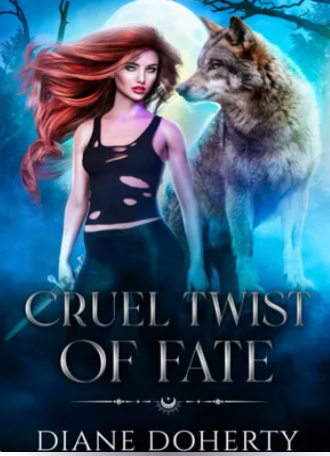
Madison Frost found her mate when she turned nineteen, the future Alpha, Scott Cypress of the Cypress Ridge Pack. Her life had never been easy. She spent most of her childhood alone or with her father. She was never really accepted by the other kids at school, but she never minded being alone. What Madison lacked in social skills, she made up for with her survival and fighting talent. Her father had taught her how to be a strong warrior and tracker. She wanted to make her father proud. She was the only thing left of his late mate, her mother. So when her eyes locked with Scott’s on her birthday, she believed the Moon Goddess was finally smiling down upon her. But on the night of the Alpha handover ceremony, everything in Madison’s life came crashing down in a cruel twist of fate. Barrett Grimm was forced to step up as Alpha of the Grimm Mountain Pack after the untimely death of his parents. He was barely eighteen and was left to run a pack and raise his baby sister, who was thirteen. Five years later, he had gained the reputation of the ruthless Grimm Alpha. Being young didn’t mean he would let others bully him or his pack. Nothing could melt his icy heart.
The Unknown Royal Luna: Cruel Twist of Fate is a high-drama paranormal romance that takes the familiar hidden-heiress and fated-mate formula and gives it sharper emotional stakes by asking whether a woman born for a throne can ever belong to herself.
Who This Book Is For
This novel is best suited to readers who enjoy werewolf romance driven by concealed identities, royal bloodlines, pack politics, supernatural destiny, emotional betrayal, and a heroine whose apparent vulnerability hides a far more dangerous inheritance.
It will particularly appeal to readers who prefer their fantasy romance serialized, twist-heavy, and emotionally immediate rather than restrained or literary. Fans of secret princess narratives, underestimated heroines, possessive alpha figures, mate-bond conflict, and dramatic revelations will find plenty to keep the pages turning.
Who This Book Is Not For
This is unlikely to satisfy readers who want subtle world-building, rigorously structured political fantasy, understated romance, or characters who always behave rationally. The novel operates through emotional escalation: secrets are withheld, loyalties shift suddenly, and revelations often arrive at the most combustible possible moment.
Readers who dislike the idea of destiny functioning as romantic authority may also struggle with the story. Like many fated-mate romances, it must constantly negotiate an uncomfortable question: when supernatural law declares two people bound to one another, how much room remains for meaningful consent?
Three Reasons to Recommend It
1. The heroine’s hidden identity creates more than a conventional power fantasy.
The “unknown royal” premise could easily have become a simple Cinderella story in wolf form: an overlooked woman discovers that she is secretly important, gains power, and proves everyone wrong. What gives this novel greater dramatic potential is that royal identity is not presented solely as a reward. It is also an inheritance of danger, obligation, and historical violence.
Her bloodline may grant her status, but it also makes her visible to forces that previously ignored or underestimated her. The revelation of power does not automatically produce freedom. Instead, it changes the nature of her captivity. She moves from being controlled because she appears powerless to being controlled because others recognize what she represents.
That tension is one of the book’s strongest ideas. The fantasy is not merely “she was special all along.” It is “she was special all along, and that may be the reason she was never allowed an ordinary life.”
2. It understands that the best werewolf romances are really stories about social power.
Pack hierarchies externalize emotional relationships. Desire, loyalty, family, violence, and political authority all become part of the same system. A romantic rejection is never only personal; it can affect rank, safety, legitimacy, and belonging. A mate bond is never merely attraction; it can become a public claim over another person’s body and future.
The Unknown Royal Luna uses this structure effectively because the heroine’s romantic fate cannot be separated from her political identity. Whoever loves her may also want access to her power. Whoever protects her may be protecting a person, a bloodline, or a future throne. The uncertainty between those motives gives the romance its most compelling edge.
The novel is at its best when affection and ambition become difficult to distinguish. A declaration of devotion can sound sincere while still serving a political purpose. Protection can feel reassuring and possessive at the same time. That ambiguity gives the story more bite than a straightforward “powerful alpha rescues mistreated heroine” narrative.
3. Its emotional excess is a feature, not an accident.
This is not a quiet novel. It is built around shocks, reversals, buried truths, heightened confrontations, and the constant threat that the heroine’s understanding of herself will be overturned again. For readers accustomed to serialized digital romance, that velocity is part of the pleasure.
The author knows how to create the particular kind of narrative hunger that keeps readers moving into the next chapter. A revelation rarely closes a question cleanly; it usually opens a larger one. Discovering the truth about identity leads to questions about lineage. Discovering lineage leads to questions about enemies. Romantic certainty produces new doubts about motive and loyalty.
There is an undeniable soap-operatic quality to the storytelling, but “soap-operatic” should not automatically be treated as an insult. At its best, melodrama gives emotional conflicts a physical and political form. Betrayal becomes exile. Desire becomes a supernatural bond. Family trauma becomes a battle over succession. The novel’s heightened style makes private pain feel consequential on the scale of an entire world.
One Reason You May Want to Skip It
The story occasionally relies too heavily on delayed communication and accumulating revelations.
The same narrative machinery that makes the book addictive can also make it feel engineered. Characters sometimes appear to withhold crucial information not because silence is psychologically inevitable, but because the plot needs another confrontation later. The repeated cycle of discovery, misunderstanding, separation, and escalation may frustrate readers who prefer character decisions to drive the plot more organically.
There is also a risk common to hidden-royalty stories: once the heroine’s bloodline becomes central, her innate status can overshadow her earned growth. The novel is most persuasive when her strength emerges through endurance, judgment, and choice. It is less persuasive when royal blood itself is treated as proof of moral worth or leadership ability.
An inherited crown can explain why the world wants her. It cannot, by itself, explain why the reader should believe in her.
Editor’s Commentary
The Unknown Royal Luna: Cruel Twist of Fate succeeds because it recognizes the emotional fantasy beneath the hidden-heiress trope. Readers are not only waiting for the heroine to discover that she is powerful. They are waiting for everyone who diminished her to realize how badly they misjudged her.
That fantasy of retroactive recognition is one of the most enduring pleasures in popular romance. The ignored woman becomes indispensable. The rejected mate becomes the center of the pack’s future. The person treated as socially disposable turns out to possess the bloodline, authority, or power on which everyone else depends.
Yet the novel is more interesting when read against that fantasy rather than simply through it. Its central question is not whether the heroine deserves recognition. She clearly does. The more difficult question is why recognition must depend on discovering that she is royal.
Would she deserve dignity without exceptional blood? Would her suffering matter if she were not secretly powerful? Would the people around her regret their cruelty if she had remained politically insignificant?
This is where the novel’s escapism brushes against a genuine critique of hierarchy. The story condemns those who judge the heroine by her apparent rank, but it also rewards her by revealing that her true rank is higher than theirs. It challenges the hierarchy emotionally while preserving it structurally.
That contradiction does not ruin the book. In fact, it helps explain why stories like this remain so compulsively readable. They offer rebellion without abandoning the fantasy of status. The heroine does not destroy the throne that excluded her; she proves that it belonged to her all along.
The romantic dimension contains a similar tension. Fated mates promise a love so profound that it transcends uncertainty, social pressure, and ordinary incompatibility. But predestination can also flatten agency. The strongest moments are therefore not those in which fate announces what the characters must feel. They are the moments in which the heroine decides what fate is allowed to demand from her.
A satisfying royal-Luna story should not end with a woman merely being identified, claimed, or crowned. It should end with her becoming capable of defining the meaning of those things for herself.
That is the novel’s real appeal. Beneath its twists, supernatural bloodlines, romantic volatility, and pack drama lies a story about the distance between being chosen and having a choice. The Unknown Royal Luna may wear the familiar clothing of commercial werewolf romance, but its most compelling conflict is unmistakably human: whether identity is something inherited from blood, imposed by society, recognized by a lover, or claimed by the self.




 千斤顶
千斤顶




 English
 简体中文
简体中文 繁體中文
繁體中文 한국 사람
한국 사람 日本語
日本語 Deutsch
 русский
 بالعربية
 TÜRKÇE
 português
 คนไทย
คนไทย french